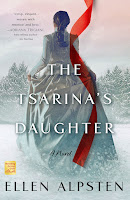
In November 2020, I participated in a book blog tour for a book called Tsarina. I am happy to present to you the follow up, The Tsarina's Daughter. You can find my original review here. I hope you enjoy the excerpts.
From the Jacket:
Ellen
Alpsten's stunning novel, The Tsarina's
Daughter, is the dramatic story of Elizabeth, daughter of Catherine I and
Peter the Great, who ruled Russia during an extraordinary life marked by love,
danger, passion and scandal.
Born into the House of Romanov to the
all-powerful Peter the Great and his wife, Catherine, a former serf, beautiful
Tsarevna Elizabeth is the envy of the Russian empire. She is insulated by
luxury and spoiled by her father, who dreams for her to marry King Louis XV of
France and rule in Versailles. But when a woodland creature gives her a Delphic
prophecy, her life is turned upside down. Her volatile father suddenly dies,
her only brother has been executed and her mother takes the throne of Russia.
As friends turn to foe in the dangerous
atmosphere of the Court, the princess must fear for her freedom and her life.
Fate deals her blow after blow, and even loving her becomes a crime that
warrants cruel torture and capital punishment: Elizabeth matures from suffering
victim to strong and savvy survivor. But only her true love and their burning
passion finally help her become who she is. When the Imperial Crown is left to
an infant Tsarevich, Elizabeth finds herself in mortal danger and must confront
a terrible dilemma - seize the reins of power and harm an innocent child, or
find herself following in the footsteps of her murdered brother.
Hidden behind a gorgeous, wildly decadent
façade, the Russian Imperial Court is a viper’s den of intrigue and ambition.
Only a woman possessed of boundless courage and cunning can prove herself
worthy to sit on the throne of Peter the Great.
Excerpt:
Prologue
IN THE WINTER PALACE,
ST. NICHOLAS’S DAY
DECEMBER 6, 1741
Ivan
is innocent—my little cousin is a baby, and as pure as only a
one-year-old can be. But tonight,
at my order, the infant Tsarwill be declared guilty as charged.
I fight the urge to pick him up and kiss him;
it would only make things worse. Beyond
his nursery door
there is a low buzzing sound, like that of angry
bees ready to swarm the
Winter Palace. Soldiers’ boots scrape and shuffle. Spurs clink like stubby vodka
glasses, and bayonets are being fixed
to muskets. These
are the sounds
of things to come. The thought spikes
my heart with dread.
There is no other choice.
It is Ivan or me. Only one of us can
rule Russia; the other one is condemned to a living
death. Reigning Russia
is a right that has to be earned
as much as inherited: he and my cousin,
the Regent, doom
the country to an eternity under the foreign yoke.
Under their rule the realm will be lost,
the invisible holy
bond between Tsar and people irretrievably severed.
I,
Elizabeth, am the only surviving child of Peter the Great’s
fifteen sons and daughters. Tonight, if I hesitate
too long, I might
become the last of the siblings to die.
Curse the Romanovs! In vain I try to bar from my thoughts the prophecy that has blighted
my life. Puddles
form on the parquet floor
as slush drips
from my boots;
their worn thigh-high leather is soaked from my dash across St. Petersburg. Despite
my being an Imperial Princess—the Tsarevna Elizabeth
Petrovna Romanova—no footman had hooked
a bearskin across
my lap to protect me against the icy wind
and driving snow
while I sat
snug in a sled;
I had no muff to raise to my face in that special
graceful gesture of the St. Petersburg ladies, the damy. My dash toward my date with destiny had been clandestine: snowfall veiled the flickering lights of the lanterns
and shrouded the city. Mortal fear drove
me on, hurrying over bridges, dodging patrolled barriers—the shlagbaumy—and furtively
crossing the
empty prospects, where my hasty passage
left a momentary trace of warmth in the frosty
air.
This
was a night of momentous decision-making that I would
have to live with forever. An anointed and crowned Tsar may not
be killed, even once he is deposed, as it sets
a dangerous precedent.
Yet he may not live
either—at least not in the minds of the Russian people
or according to the diplomatic dispatches sent all over
Europe.
What then is to become of the boy? I feel for Ivan’s limp little hand. I simply cannot resist—never could—nuzzling his chubby,
rosy fingers, which
are still too small
to bear the Imperial
seal. We call this
game a butterfly’s kiss; it makes
him giggle and
squeal, and me dissolve with
tenderness. I drink
in his scent, the talcum powder
blended in Grasse
for his sole use—
vanilla and bergamot, the
Tsar’s perfume—carefully recording it
to last me a lifetime. The men outside
fall quiet. They are waiting
for the decision that will both save and damn me. The thought
sears my soul.
In Ivan’s nursery
the lined French
damask drapes are drawn.
Thick, pot-bellied clouds
hide the December
new moon and stars,
giving this hour a dense
and dreadful darkness. During the day the seagulls’ cries freeze on their beaks;
the chill of night grates skin raw. Any light
is as scarce and dear
as everything else in St. Petersburg. The candle-sellers’ shops, which smell of
beeswax, flax, and sulfur, do brisk
business with both Yuletide and Epiphany approaching. On the opposite quay the shutters on the flat
façades of the city’s palaces
and houses are closed, the windows behind them
dark. They are swathed in the same brooding silence
as the Winter Palace. I am in my father’s
house, but this does not mean
that I am safe. Far from it—it means
quite the opposite. The Winter Palace’s
myriad corridors, hundreds
of rooms, and dozens of staircases can be as welcoming as a lover’s embrace
or as dangerous as a snake
pit.
It is
Ivan or me: fate has mercilessly driven us toward
this moment. The courtiers shun me: no one would
bet a kopeck on my future. Will
I be sent to a remote convent,
even though I do not have
an ounce of nun’s flesh about
me, as the Spanish envoy, the Duke of Liria, so memorably recorded?
I had once been forced to
see such an unfortunate woman in her cell; as intended, the sight
instilled a terror
that would last me a lifetime. Her shorn head was
covered in chilblains, and her eyes
shone with madness.
A hunchbacked dwarf, whose
tongue had been
torn out, was her
sole companion, both shuffling about in rotten
straw like pigs in
their sties. Or perhaps there is a sled waiting
for me, destination Siberia? I know about
this voyage of no return;
I have heard the cries, seen the dread,
and smelled the fear of the banished
culprits, be they simple
peasants or even the Tsar’s best
friend. By the first anniversary of their
sentence, all had succumbed to the harsh conditions of the East.
Maybe a dark
cell in the Trubetzkoi Bastion, the place nobody
ever leaves in one piece, will swallow
me; or things will be simpler, and I am fated to end up facedown in the
Neva, drifting between
the thick floes
of ice, my body
crushed and shredded
by their sheer force.
The
soldiers’ impatience is palpable.
Just one more breath! Ivan’s
wet nurse is asleep, slumped
on her stool, resting amid his toys:
the scattered pieces of a Matryoshka doll, wooden boats, a mechanical
silver bear that opens its
jaws and raises
its paws when
wound up, and a globe inlaid with Indian ivory and Belgian émail. One
of the
nurse’s pale breasts is still bare from the last feeding;
she was chosen for her ample alabaster bosom in Moscow’s raucous
German Quarter. Ivan is well cared for: Romanov
men are of weaker
stock than Romanov women, even if no one ever dares to say so. I
celebrated his first
year as a time of wonder, offering my little cousin
a cross studded
with rubies and emeralds for his christening, a gift fit for a Tsar, and put myself in debt to raise an ebony colt
in my stables as his Yuletide present.
Ivan’s breathing is growing heavier. The regiment outside
his door weighs on his dreams.
As I touch his sides,
his warmth sends a jolt
through my fingers, hitting
a Gold in my heart. Oh,
to hold him one more time and feel his delightful weight in my arms. I
pull my hands back, folding them,
though the time for prayers has passed. No pilgrimage can ever absolve
me from this sin, even if I slide
across the whole of Russia
on my knees. Ivan’s lashes
flutter, his chin wobbles, he smacks his pink and shiny lips. I cannot
bear to see him cry, despite the saying of Russian serfs:
“Another man’s tears
are only water.”
The lightest load
will be your
greatest burden. The last
prophecy is coming to pass. Spare me, I inwardly
plead—but I know this is my path, and I will have to walk it to the end, over
the pieces of my broken heart. Ivan slides back into slumber;
long, dark lashes cast shadows on his round cheeks,
and his tiny
fists open, showing pink, unlined palms. The sight stabs
me. Not even the most adept fortune-teller could
imagine what the future has in store
for Ivan. It is a thought that
I refrain from
following to its conclusion.
Beyond the door
utter silence reigns.
Is this the calm
before the storm my father taught
me to fear when we sailed the
slate- colored waters of the Bay of Finland? His fleet had been rolling
at anchor in the far distance, masts rising like a marine forest. “This is
forever Russia,”
he had proudly announced. “No Romanov
must ever surrender what has been gained by spilling
Russian blood.”
In order to strengthen Russia, Father
had spared no one. My elder half-brother Alexey, his son and heir, had paid the ultimate
price for doubting Russia’s path to progress.
Steps approach.
My time with Ivan, and
life as we know it,
is over. I wish this
were not necessary. The
knock on the
nursery door is a token rasp of knuckles; so light, it belies its true purpose.
It is time to act. Russia will tolerate
no further excuses.
The soldiers’ nerves are as taut as the spring in a bear
trap. I have promised them the world: on a night like this, destinies are forged, fortunes
made and lost.
“Elizabeth Petrovna Romanova?” I hear the
captain of the Imperial Preobrazhensky Regiment
addressing me. His son is my godchild, but
can I trust him completely for all that?
I feel as if I am
drowning and shield Ivan’s
cradle with my body. In the gilt-framed mirrors I see my face floating ghostly pale
above the dark green uniform
jacket; my ash-blond curly hair has slid down from beneath a fur cap. On a simple
leather thong around
my neck hangs
the diamond-studded icon
of St. Nicholas that is priceless to me. They will have to prise
it from my dead
body to take
it from me.
I am almost
thirty-two years old.
Tonight I shall not betray
my blood.
“I
am ready,” I say, my voice trembling, bracing
myself, as the door bursts
open and the soldiers swarm in.
Everything comes at a price.
Excerpt 2:
It was winter, and Ded Moroz—Father Frost—had touched
my soul. Augustus stroked
the hair gently
from my forehead as I
cried on his shoulder,
both of us numb with
grief and terrified
by Tolstoy’s and Feofan’s incarceration. “I will keep you safe. We will be
formally engaged as soon as the mourning
period ends. Come,”
said my fiancé, leading
me to the bed. We lay together between
the starched linen and the heavy furs. Feeling
his strength next to me was
the best consolation I could imagine.
He whispered endearments to me as well as promises of eternal love.
The moment for me to leave for Holstein and marry
Augustus there
drew closer. To arrange to receive my dowry, my inheritance from Mother, and
all the smaller
sums and gifts
that had been
promised to me on marriage, I asked for an audience
with Menshikov. The young Tsar was once more in Oranienbaum, supposedly because the Baltic air was good for his lungs.
Menshikov made me wait for long weeks. The hour finally
came early on a late
spring morning, just
days away from
my formal engagement to Augustus. Mother’s death had delayed the cere- mony, but it would still
coincide with the public announcement of Petrushka’s engagement to Maria Menshikova. A fresh wind chased
away the last of the winter
chill, helping along
the first buds
on the
fruit trees planted
on the quays; on the Neva the last ice broke, the
glare of it flashing among the steely
waves. I still
wore white, mourning
my mother, when
Menshikov invited me into my father’s former study.
“Come in, Lizenka,” he said, withholding my proper
title, his familiarity a calculated slight.
Yet I should not play into his hands by reacting
angrily. Worse than
his insults was
the sight of him
sitting at my father’s
desk, legs stretched out and feet
comfortably crossed. His fingers twirled the great Tsar’s quill—what for? He could not even read or write!
The man he was today had obliterated any memory
of the loyal, low-born friend
he had pretended to be, who
had been raised
literally from the
Russian dust.
“What a delight
to see you.” Menshikov shifted one buttock half-heartedly but stayed seated
in my presence on a chair my father had made. The great
Tsar had lathed the night hours away to chase his demons or hatch new ideas.
“I
see you are busy,”
I said, trying
not to let discomfiture color my tone.
“But where is the rest of the State
Council? I thought
this was a formal meeting.”
“Too many
cooks spoil the broth.”
He crossed his arms
behind his head and leaned back in the chair, balancing it on two legs like a
schoolboy. “How can I help?”
“I
come for my mother’s bequest
to me. My dowry, as well as recompense for relinquishing my right to the throne to Petrush- ka’s possible heirs. It can all be sent to a Hamburg bank. Mother’s plate, silver, and jewels I shall take
with me in person. I trust no one here,” I added, smiling
sweetly, looking
him straight in the eye. “Bequest? What bequest?” Menshikov shuffled some papers on the desk, as if to find the answer there. He frowned and shook his head. “I am at a loss, Lizenka.
Nothing is owed to you, and the Tsar has generously given all your late mother’s belongings to his beloved fiancée,
my daughter Maria.”
He gave a short, wolfish grin. “I was promised one million roubles
in recompense for relin- quishing
to Petrushka and his heirs
my right to the throne—” I started, unable to
contain my anger.
“The
wisdom of your
decision will be remembered. Tsar Peter is delighted.”
“I imagine. My mother’s
will . . .”
“. . . of which I am the careful executor, remember.”
“Careful indeed,” I interrupted him,
my voice brittle, remembering my mother’s lying-in-state: had Menshikov himself plucked the rings off her fingers,
carelessly breaking a bone or two in the
process? Had he untangled the tiara from her tresses, or had he simply torn it off, and clumps
of hair with it? I hated him so much then that my voice failed
me. I had to clench
my fists so as not to claw him. “What shall I live on?” I asked,
fighting back tears.
“Augustus is a minor prince of the House of Holstein.”
“You made your bed,
you must lie in it. Surely young
Augustus has a stipend or possibly wages
as a sailor in the Holstein Navy?”
“Not that
I know of.” A sailor’s
wages would not pay for a single ribbon on one of my dresses. From the impoverished existences of my cousins
Ekaterina Ivanovna and Anna Ivanovna, I knew what kind of life I was facing.
Augustus and I were to reside in a far-flung,
freezing corner of an inhospitable castle in Gottorf,
more suffered than welcome
there, running our meager household and touchy retinue on a shoestring. Each log on the fire
would be counted,
and only rind should
enrich the pea soup,
never proper bacon.
During big family dinners,
once or twice a year, we would be served last with the scraps from the
platters, the
servants already hovering, im- patient to get away. At Easter
my painted egg would
be cracked; for Yuletide an unwanted gift from the past year’s celebration would be offered.
My children stood
to inherit nothing. For as long as Karl
reigned as Duke in Holstein, we would walk two, if not three, steps behind him and my sister. How had life turned
the tables so swiftly
on me? Well, I could do it, I decided: I could live
with the fall
in status because I loved Augustus.
Menshikov watched me, alert. “There
is no room for further negotiation. All your mother’s
belongings are already with Maria,” he
said. “Including her furs. My daughter, the future Tsarina, does love a good sable coat. Petrushka
will offer her your mother’s
crown.
My grandchildren will rule over All the Russias.
Better give in, Lizenka. We are a family
now. One large, loving
family.”
Give in? Never!
He was basted in self-regard. I fought back the
tears for good.
I was not a little
girl but a Tsarevna
of All the Russias, claiming her rightful inheritance. Any show of weakness
would be fatal.
“You owe everything you are to my father.
My mother, the Tsarina, left her daughters
a fortune.”
Menshikov slithered out from behind the
desk toward me, teeth bared, all vice and venom.
“Believe me, I am intent on repaying
all debts. Without me, Petrushka would not become
Tsar. There is always someone
else, Lizenka—someone such
as you.”
Me?
His
eyes pinned me to the spot. “As you so helpfully recently pointed out, you have not yet renounced the throne. You would make a spirited Tsarina, wouldn’t you?
Possibly the regiments would support you, for some . . . consideration?” It took
all my self- control not to slap him for that insult.
“Whoever is favored
by the Russian regiments, is favored by fate. But
there can only
be one ruler, my dear girl.”
My dear
girl. I saw every
broken blood vessel
in his cheeks
and could smell his perfume of sandalwood and jasmine, too sweet for a
man, as well
as his sour breath—his steady
chewing of cumin
was in vain; his teeth
had reached the point of no return.
The threat was clear: if I did not leave for Holstein, he would stalk
and slay me here. Better not to test his
ingenuity in dreaming up a justification for it.
Menshikov smiled as if reading
my thoughts. He laid one hand casually on the
nape of my neck.
I froze at his
touch, our gazes locking. For an incredible moment
it seemed he might actually force a kiss on me. I stared at him, and he hovered, undecided, not moving any closer. Finally, he said: “So in memory
of all the generosity your father showed
me, I am letting you live. More so, I am letting
you leave. How long would
you survive a damp,
freez- ing nunnery,
lovely Lizenka? There
is not a shred of sanctity about you. I know what Augustus
and you did in Peterhof.”
I blushed deeply.
“But what
might His Majesty
think of that, who loves
you as an aunt and wishes
to respect you as a Tsarevna
of his house?”
I freed myself from Menshikov’s grip, my eyes blazing.
“I am engaged to marry Augustus,” I said, gathering
my last shreds of dig- nity.
“Yes, he is only your husband-to-be,”
Menshikov chuckled. “That which made
your father virile,
makes you a harlot. Such
behavior in a woman warrants a heavy punishment.”
“What do you mean?”
“Death,” he mouthed, as ruthless as a gun dog. “The choice is yours. Cease your demands, and your carriage
to Germany is ready
to depart at any time you choose. Persist
in them, and you will be
shamed and punished severely.
Now is there anything else? I have a country
to rule. But I am not ungrateful.” Once
more he sifted through the papers that were waiting
to be sealed and signed.
“I might or might
not forget the
words you spoke
to me today.”
Anger
and pride won over fear. If I had to
leave the only country I should ever
love, I refused
to do so like a stray dog,
my tail between my legs. With a single movement, I swiped the desk
clear of all the papers.
They billowed and flew up in the air be- fore scattering all over the beautiful rugs and parquet,
like doves spreading their
wings. Now it was I who leaned in, placing my knuckles on the Tsar’s desk. Menshikov shrank back, taken by
surprise. Time flowed
slowly, like fresh sap bleeding from a tree. It was true, the choice was mine.
Menshikov startled when
I spat: “Rule
the country? You might as well pee against
the wind, callous
coward that you are. A man
like you cannot
even begin to rule Russia.
You are dust!”
The last vestiges
of civility between us had disappeared. Menshikov’s
eyes became hard and unforgiving, that nasty smile lurking at the
corners of his mouth. I should not be fooled
by it ever again, but would hide my feelings. Otherwise the hunter in him would feast on them, devouring his prey’s
most tender part with relish: the heart.
“And you? No wonder France rejected you! What a joke it was to the
Bourbons: the illegitimately born daughter
of a serf, a washer-
maid, wanting to reign in Versailles! And France knew only half the story. I plucked
your mother from a heap of prisoners of war
because she was as irresistible as a beautiful animal. She had me to thank for everything—and she did, believe
me, many times
over. You have forgotten where you come from, Lizenka.”
Menshikov was not
wrong.
He did not know how grateful I was for the reminder.
About the Author:
ELLEN ALPSTEN was born and raised in the
Kenyan highlands. Upon graduating from L'Institut d'Etudes Politiques de Paris,
she worked as a news anchor for Bloomberg TV London. Whilst working gruesome
night shifts on breakfast TV, she started to write in earnest, every day, after
work and a nap. Today, Ellen works as an author and as a journalist for
international publications such as
Vogue,
Standpoint and
CN Traveller. She lives in London with her husband, three sons and
a moody fox red Labrador. She is the author of
Tsarina.
(Photo Credit to Andreas Stringberg)
 My Evil Mother: A Short Story by Margaret Atwood